AP Royal Oak " Jumbo" Ultra-Thin Automatic Flying Tourbillon Chronograph (RD#5)
Design: 26545XT. OO. 1240XT. 01
To celebrate Audemars Piguet's 150th anniversary, the newest masterpiece in this collection is usually unveiled, centered around the most prestigious yet technically demanding complications in watchmaking-the stop-watch. Five years in the producing, the Royal Oak " Jumbo" Ultra-Thin Automatic Traveling by air Tourbillon Chronograph RD#5 is definitely powered by the new Competence 8100 movement, perfectly blending together the flyback chronograph feature with the flying tourbillon.
Impressively, the case holds the original dimensions of the Big series-39mm x 8. 1mm. The case's middle level is crafted from titanium, even though the bezel, pushers, crown selectivo, and lugs are made of Obstruct Metallic Glass (BMG)-a arrhes alloy originally used in the first Royal Oak " Jumbo" ultra-thin watch specially created for the Only Watch 202. BMG's exceptional scratch level of resistance and durability make it ideal for the high-performance chronograph. The wathe mechanism is breathtaking; is actually no exaggeration to say the item reminds us that we often consider a subject has been exhausted, simply to find it's just holding out to be examined from a diverse perspective-in this case, a truly special perspective. Unlike traditional hammers and cams, this observe uses a rack and pinion mechanism for the zeroing actions. Furthermore, the rack in addition to pinion provides a concise solution to generate the index heart beat for the instantaneous minute hop. However , individually, both characteristics employ a complexity and unconventionally design never before seen in chronograph watches. The question is, exactly why?
top quality replica watches
replica watches sale
swiss watches replica
The answer lies in the search for a different kind of chronograph, using a redesigned control system buildings that results in a softer truly feel for the pushers. In classic chronographs, the stiff really feel of the pushers stems from the machine surrounding the column steering wheel. Pressing the start or end button moves the handle forward one notch. Each and every forward movement requires a early spring to lift off any ratchet tooth and then planting season back onto the next, making stiff, resistance-prone feel. Concurrently, the rotation of the section wheel must also drive redressers, each held in place by simply its own spring. The strain applied to the column tyre must indirectly overcome these kinds of forces to lift this. In flyback chronographs, stress is reduced because the reset button lever does not need to pass through the actual column wheel. Furthermore, the particular lever is typically longer, stretching from the pusher to the spine wheel. Pressing the pusher drives this long switch, which in turn rotates the line wheel via a spring-loaded pawl. This length introduces flexibility, absorbing energy before virtually any movement occurs.
Due to the more direct relationship, the reset button demands more force. Pressing typically the button winds a sort spring, which must be solid enough to firmly affect the reset hammer in opposition to a cam on the timepiece wheel. When the reset option is pressed, the spy cams can be in any position, and so the spring must provide adequate energy to quickly give back each chronograph wheel for you to zero in a clean, clean motion, regardless of how many desks are operating simultaneously. Consequently , the reset button in the traditional chronograph is almost constantly the heaviest.
In the RD#5, the pushrod is closer to the vertebral column wheel, making the operating pedal short and sturdy, demanding less force. It's important to observe that the column wheel would not directly drive the braking mechanism or clutch lever, but alternatively acts only on a hinged intermediate control lever. This particular control lever is coupled to the clutch lever. As the section wheel rotates and lets out, the control lever revolves accordingly, causing the clutch spring and coil to engage the clutch tire. The user only feels often the resistance of the column controls spring (still producing a highly detailed click), while the load about the clutch spring is début internally by the mechanism. Put simply, positioning and actuation are generally separate. The finger solely needs to apply enough push to turn the column steering wheel, while the stored spring strength is responsible for the actual engagement as well as disengagement of the clutch.
Meanwhile, an reliable finger on the intermediate button controls the second wheel. Inside stop mode, it pushes the jump wheel, attractive it with the chronograph mere seconds wheel; in start function, it retracts the get wheel, releasing it. This specific ensures that the locking and also unlocking of the chronograph moments wheel is perfectly coordinated with the engagement and disengagement of the clutch, requiring simply no additional force on the spine wheel.
In the same way, the absence of a cams and reset hammer minimizes the load on the reset switch. The seconds, minutes, along with hours wheels are each and every connected to a gear having sector teeth. These things mesh with their respective holders, which gradually accumulate power as the gears rotate. After reset, the stored vitality is released, driving the actual counters to zero. The particular reset button does not supply energy to drive the palms; it simply actuates a six-armed reset lever that concurrently pushes or lifts the particular pawls and pinions of all locking chronograph wheels. When released, the rack rises back under its own springtime, cleanly resetting the displays to zero.
Because this is a flyback view, the reset lever is just not controlled by the column wheel yet is engaged directly by means of pressing the button. This kind of separate design reduces typically the force required to press often the button each time. The totally reset lever features a dedicated provide that precisely disengages the actual clutch lever the instant other arms release the pawl and ratchet. The time counter seconds hand, along with it has the extended minute and time wheels, then separates in addition to rotates freely, returning to no under the action of the roof-rack and spring. Once the recast button is released, the particular reset lever springs to its original position, typically the clutch re-engages, and the stop-watch function seamlessly resumes operations. To reduce inertia, many pieces of the chronograph function are constructed of titanium, such as the chronograph just a few seconds hand and chronograph rims.
The effect must be quite noticeable for the customer. Unlike the harsh spring-striking noise of traditional reset redressers, its operation is easy, rapid, and light. The pusher travel is extremely short-only concerning 0. 3 mm-requiring merely a fraction of the force needed for a standard chronograph, more quite like the feel of a smartphone key than the heavy mechanical sense we are accustomed to. This is a enjoy worth experiencing firsthand. Photos can only showcase the difficulty of its design; just by actually wearing it is one able to truly appreciate its elaborate mechanical structure.
luxury fake watches
Ulysse Nardin fake watches
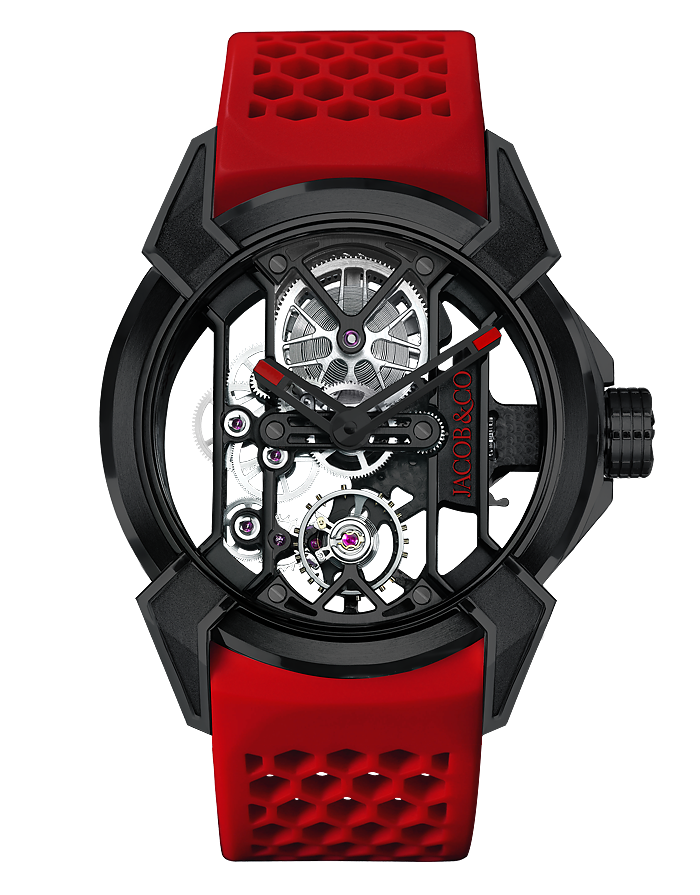
Jacob and Co. Epic X fake
It is well worth noting that this chronograph furthermore features an instantaneous second jump function. As the wathe seconds wheel completes one particular revolution, its bevel products drives the rack onward until the bevel reaches the opposite end. At this point, the gear disengages from the rack, and the come back rack quickly returns to help its initial position beneath the action of a spring, along with counterweights ensuring balance. That retrograde motion is manipulated by a pawl-equipped lever in which moves the minute wheel frontward one notch.
Similar to the spring in the secs rack, the spring inside the minutes rack does not behave directly on the minutes slab itself, but rather on the handle. The lever oscillates only some degrees each minute increment. This particular design ensures that the early spring load remains almost regular, whether the spring is totally loaded or fully introduced, thus generating stable torque and making the minute clicks crisp and clean every single 60 seconds.
Every single 60 minutes, the same principle is applicable to the hour wheel. Through the minute hand's retrograde returning, the lever with the hours pawl drives the hour or so wheel forward. However , as the hour hand is immediately acted upon by the spring, the torque varies over a larger range. As the minute side cycle nears its ending, the hour pawl progressively engages with the hour tyre, and finally, the hour give jumps to lock that to the next mark, achieving near-instantaneous rotation.
This specific clutch differs from frequent horizontal or vertical motorola clutch systems, although it borrows capabilities from both. The clutch system wheel is mounted on some sort of shaft that can slide axially between two positions. Using one side, it is permanently employed with the movement's drive tire; on the other side, it can engage or maybe disengage with the chronograph mere seconds wheel. When the chronograph functionality is activated, the core control lever rotates, liberating the clutch lever. Free of its restraint, the the whole length and clutch wheel proceed laterally under the action with the clutch spring, entering often the engaged position, where the clutch i465 black wheel engages with the timepiece seconds wheel.
This allows the clutch to maintain the actual visual elegance of side to side coupling while engaging since smoothly as vertical coupling, avoiding bumps, resistance, as well as bounce. The drive controls is part of the tourbillon dog crate, meaning the chronograph perform is driven by the parrot cage. The flying tourbillon, just like the one in the RD#3, is made of ti and is driven by the previous wheel in the gear coach on its outer advantage, thus reducing thickness. Inside, it features an escapement optimized for long traveling and a free-sprung balance by having an embedded counterweight.
The most striking aspect of this specific movement is its essential design. The manual as well as automatic winding trains, the particular adjusting train, and the accessory train are all located on the call side, allowing the connection side to be almost totally dedicated to the chronograph performs. This is thanks to its peripheral winding rotor. Unlike typically the central rotor stacked over traditional movements, this one runs on ball bearings on its circumference, with all the chronograph mechanism running alongside its track. This gets rid of one of the thickest components in a very traditional automatic winding movements, allowing for a rearrangement from the automatic winding train with no increasing vertical volume.
The function selectivo uses two stacked superstar wheels to control the moving over between winding and changing. A pusher integrated into often the crown allows switching involving the two modes, while a new reversing mechanism isolates the 2 trains, ensuring only the chosen train is operational. This kind of design allows the rotating and adjusting trains to get located on the same side in the movement, eliminating the need for regular sliding gears. The mainspring barrel itself is also pretty unique. It's not merely a halted mainspring barrel supported simply by its base; it is structure is further made easier to reduce thickness. The ratchet itself encases the mainspring, eliminating the need for a lens barrel cover. The mainspring gun barrel is no longer a closed cyndrical tube but a simplified cylindrical wall with teeth for the outer edge, lacking the two a base and a cover, hence reducing its height.
All these solutions usually are convincing, but what's genuinely impressive is the immense hard work the designers poured directly into reimagining the chronograph design and style to create a smoother pusher. It truly is this unconventional ambition this defines the RD sequence, a decade-long endeavor finishing in the RD#5: taking the thing that was considered a finished product or service and refining it together with immense patience, meticulousness, and also craftsmanship, proving that it continue to holds limitless possibilities. That reminds us that progress inside watchmaking rarely comes from incorporating more functions, but coming from rethinking what already is present, and the best progress arises from enhancing the user experience, and thereby, the ownership experience alone.