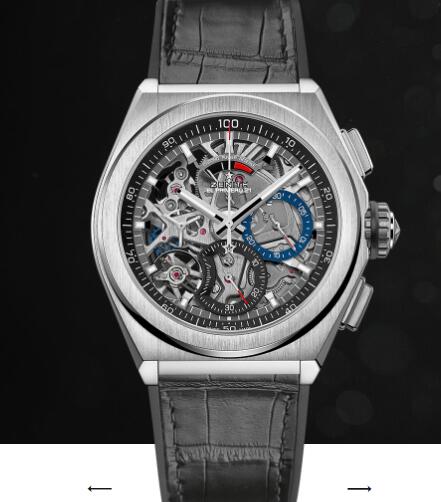
Zenith's Real AI Play Is Not in the Movement-It Is in the Supply Chain
Zenith will not publicize an AI-designed tourbillon. Its CEO talks about a good inflexible supply chain as well as 40 in-house engineers. Here is exactly why the most consequential AI work on Zenith may be invisible-and why that is the point.
Zenith's general public AI narrative is slim on flashy demos and also thick on operational dialect: inflexible supply chain, in one facility movement production, 40 technicians optimizing calibres. That is not the weakness in the story. It does not take story-AI in high the making of watch often looks more like preparing software than a robot in the bench.
H1: Zenith's Real AI Play Is Not in the Movement-It Is in the Supply Chain
Zenith can make an unlikely poster kid for AI in horological industry. There is no widely publicized generative-design tool, no computer-vision examination system branded with the celebrity logo, no AI-assisted repair program making the rounds in Watches and Wonders. What Zenith has is a CEO who took over in January 2024 and immediately recognized the supply chain as the brand's binding constraint. “We possess a inflexible supply chain, ” Benoît de Clerck stated, adding that integrating brand new technologies, including artificial cleverness, could be beneficial in decreasing the time it takes to produce watches.
Which sentence is easy to gloss over past. It is also the most truthful description of where AI really creates value in a completely integrated Swiss manufacture.
The Constraint Is Not the actual Calibre. It Is the Calendar.
Zenith constitutes a high proportion of the movement parts in-house along with employs roughly 40 technical engineers working on optimizing existing calibres and developing new types. The El Primero's 278 components are a manufacturing accomplishment as much as a horological 1; a high-frequency integrated chronograph at 5 Hz needs tolerances and process manage that few facilities may sustain. But technical capacity is not the same as throughput. The manufacture can machine a component to micron precision but still lose weeks because a set is waiting on a heat-treatment slot, a component is kept at an outsourced finishing phase, or a quality decision is actually sitting in a queue.
This is the terrain wherever AI in watch production supply chain operates. Machine-learning models applied to production organizing can optimize fabrication sequences against capacity, delivery home windows and cost; predictive servicing can flag a device drift before it creates a nonconforming batch; demand-sensing can transform component orders to real sell-through rather than a seasonal prediction. non-e of this produces a picture of a tourbillon. All of it decreases the elapsed time among a customer order and a shipped watch-the exact variable Zenith's CEO identified as the problem.
Zenith's context sharpens the stakes. The brand will be owned by LVMH, in whose watch division has been merging industrial control over crucial supply chains, including via a minority stake in Los angeles Joux-Perret aimed at securing movement access for TAG Heuer, Hublot and Zenith. LVMH's Watch Week 2026 noticed six new Defy versions, including the first Defy Views Tourbillon Skeleton, built round the high-frequency El Primero 3630 SK. Product ambition for sure level-high-frequency, skeletonized, tourbillon-puts stress on every upstream process. A versatile supply chain is not a great operations nicety. It is the precondition for bringing complicated timepieces to market without carrying a few months of immobilized work-in-progress.
“Inflexible” Is an AI Problem in Disguise
Supply-chain inflexibility within watchmaking rarely comes from a single bottleneck. It comes from the discussion of long component business lead times, small batch dimensions, outsourced specialty processes, high quality holds, and the difficulty associated with reallocating capacity without destabilizing a hand-intensive assembly circulation. These are exactly the conditions below which machine learning with regard to production planning and need forecasting outperforms spreadsheet reasoning. A model can understand the historical variance of every process step, weight providers by actual on-time overall performance rather than contract terms, in addition to simulate the downstream a result of a schedule change prior to it is committed.
The Deloitte Deluxe Watch Industry Study reported in industry coverage locations AI among the top styles in the sector, and professionals consistently locate its effect in forecasting, quality handle and early design instead of final assembly. Zenith's mentioned priority fits that chart precisely. The CEO failed to promise an AI watch manufacture. He described a brand that must make better decisions about time-manufacturing time, supplier time, shipping time. That is a forecasting as well as scheduling problem. It is also an issue where AI has a measurable track record outside watchmaking, and also where the barrier to ownership is organizational rather than computer.
What “AI” Looks Like Inside a Manufacture
The least attractive and most consequential AI deployments in Swiss watchmaking frequently look like enterprise data facilities. Breitling's 2025 move to SAP Business Data Cloud-explicitly presented as enabling AI-driven decision-making and breaking down data silos-is one visible example of an extravagance watch brand using AI for planning and stats. The pattern is common: unify production, inventory, provider and sales data; teach models on the unified coating; use the output to make arranging and sourcing decisions which humans previously made upon instinct and local knowledge.
For Zenith, a brandname with deep in-house motion competence and a publicly recognized supply-chain rigid structure, the particular sequence is likely similar. The actual raw material is not any neural network. It is thoroughly clean, unified operational data. Without having that, “AI” remains some sort of pilot project. With it, typically the manufacture can start to answer queries it could not previously solution: which calibre variant uses the most engineering hours for each unit; which supplier's lead-time variance actually drives skipped delivery dates; which period of finishing is the correct constraint during a tourbillon release. Those answers do not substitute watchmakers. They tell the folks running the manufacture where you can deploy watchmakers next.
The Brand-Narrative Tension
There is a tension here that will Zenith will have to manage. Luxury watchmaking sells a story regarding patience and handwork; a new supply chain optimized through machine learning can seem like the opposite of that story. The particular industry's own advisors recognize the difficulty: it is “very difficult for an industry relying on the narrative based mostly on custom and craftsmanship to acknowledge that new technology could help to enhance the business, ” even though numerous brands now use new technology at different levels to further improve internal processes.
Zenith's strategic repositioning towards the top of the market, introduced in late 2026 with a personnel consultation affecting roughly one hundred of 196 manufacture functions in Le Locle and extra international positions, makes in which tension sharper. The company clearly attributed the move to a place changed by the strong Swiss franc, US tariffs, along with declining demand in the Middle Eastern and Asia-not to AI. But the same pressures-higher expenses, smaller volumes, more expensive watches-are precisely what make AI-driven producing efficiency attractive. A brand relocating upmarket needs fewer, more difficult, higher-margin watches. That is a blend that rewards supply-chain accuracy and penalizes schedule deviation. AI's contribution is not to help make the watch cheaper. It is to really make the manufacture more predictable, so the engineering hours that do can be found are spent on movements, not really on chasing parts.
The Takeaway
Zenith may be the counterexample to the assumption this AI in watchmaking should announce itself through a noticeable product feature. The brand's public AI surface area is usually small because the problem it really is solving is operational. A good inflexible supply chain, 40 engineers optimizing calibres, any portfolio moving toward high-frequency skeleton tourbillons, and a owner consolidating movement supply-those are the conditions under that forecasting models, predictive upkeep and production scheduling turn out to be strategically decisive.
The hand which assembles an El Primero tourbillon is not going anyplace. But the probability that the components arrive in the right order, on the right stage of completing, with the right quality decision currently made, is increasingly a system output. That is what AI in Swiss watchmaking procedures looks like when the brand is definitely honest about its logjam. It is not a robot with the bench. It is a better response to the question: what ought to we make next, so when will it be ready?

No comments:
Post a Comment